
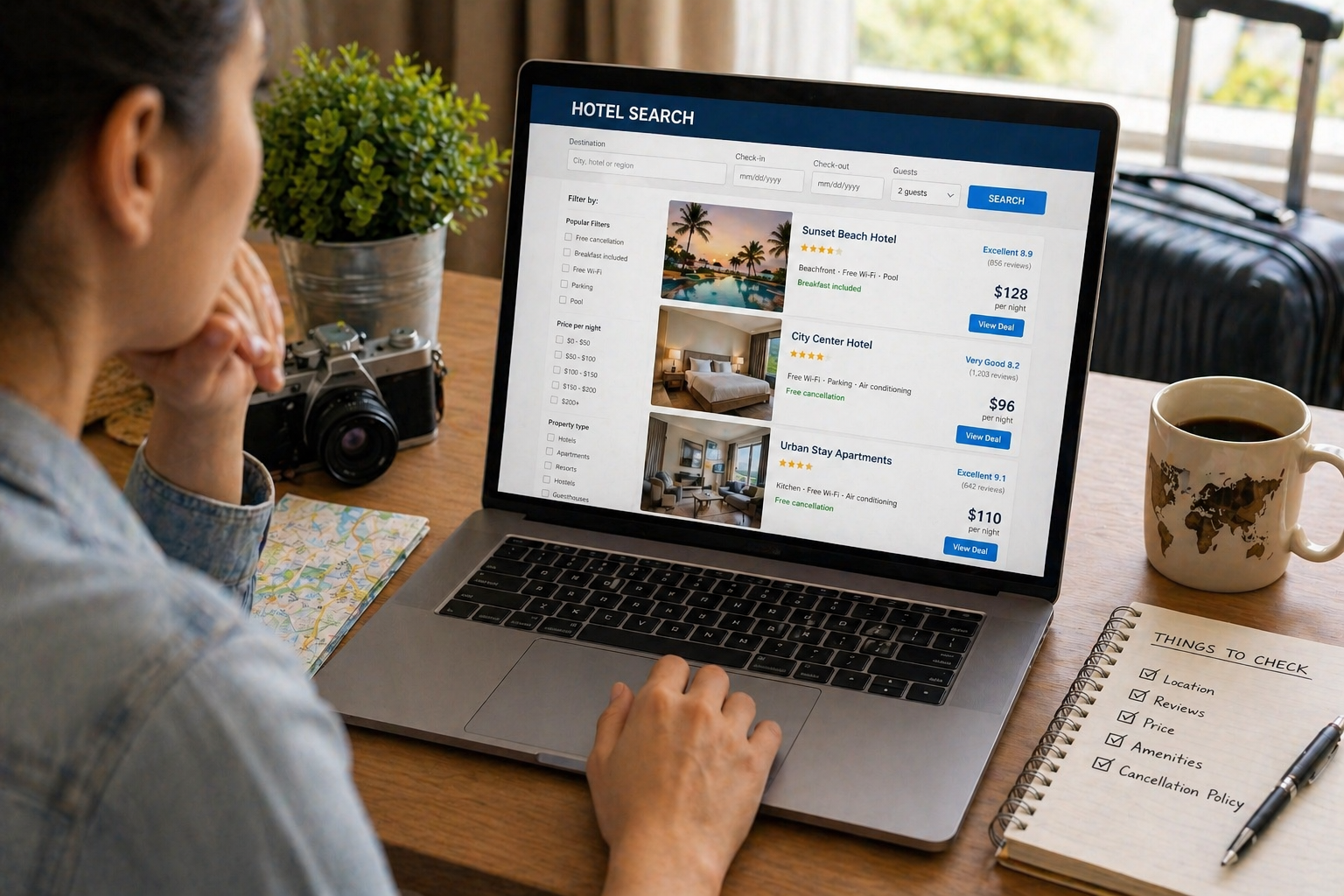
Booking a hotel online is convenient, fast, and often full of options. In just a few minutes, you can compare prices, look at photos, read reviews, choose a room, and confirm your stay. But because the process is so easy, many travelers book too quickly and later discover problems that could have been avoided.
A hotel may look beautiful in photos but be far from everything. A low price may hide extra fees. A good rating may not reflect your personal needs. A room may seem perfect until you realize it has no window, poor Wi-Fi, limited check-in hours, or a strict cancellation policy.
Before booking a hotel online, it is worth slowing down and checking the details carefully. A little research can protect your money, comfort, safety, and peace of mind.
Know the Purpose of Your Trip
Before choosing a hotel, think about why you are traveling. The best hotel for a romantic weekend may not be the best one for a business trip, family vacation, solo adventure, or quick overnight stay.
If your trip is focused on sightseeing, location may matter more than room size. If you are traveling to rest, comfort and quietness may be priorities. If you are working, reliable Wi-Fi and a desk may be essential. If you are traveling with children, space, breakfast, and safety can make a big difference.
When the purpose of the trip is clear, it becomes easier to filter options and avoid being distracted by features you do not need.
A good hotel should support the kind of trip you want to have.
Check the Location on a Map
Location is one of the most important details to verify before booking. A hotel can advertise itself as “near the center” or “close to attractions,” but these descriptions can be vague.
Open the hotel location on a map and check the real distance to the places you plan to visit. Look at transportation options, walking routes, restaurants, markets, and nearby services.
Also check how long it takes to reach the hotel from the airport, bus station, train station, or main road. If you will arrive late at night, make sure the route feels practical and safe.
A cheaper hotel far from everything may end up costing more in transportation and wasted time.
Research the Neighborhood
The neighborhood can affect your entire experience. A hotel room may be clean and comfortable, but if the area is noisy, unsafe, isolated, or inconvenient, the stay may become stressful.
Search for information about the neighborhood. Is it good for tourists? Is it walkable? Does it have restaurants nearby? Is public transportation easy? Is it quiet at night? Are there areas to avoid?
Read reviews that mention the surroundings, not only the hotel itself. Guests often describe whether the location felt safe, lively, convenient, or difficult.
The right neighborhood can make your trip smoother and more enjoyable.
Read Recent Reviews Carefully
Reviews are one of the best tools for evaluating a hotel online. However, do not look only at the average rating. Read the comments carefully, especially the most recent ones.
Hotels can improve or decline over time. A review from several years ago may not reflect the current situation.
Look for repeated comments. If many guests mention cleanliness problems, noise, poor service, weak Wi-Fi, uncomfortable beds, or misleading photos, take that seriously. One negative review may be personal preference, but repeated patterns are important.
Also read reviews from travelers similar to you. Families, couples, business travelers, solo travelers, and budget travelers may notice different things.
Compare Photos From the Hotel and Guests
Official hotel photos are usually taken with good lighting, wide angles, and careful staging. They can be useful, but they may not show the full reality.
Look for guest photos when available. These often show the room, bathroom, view, breakfast, pool, entrance, and common areas more realistically.
Pay attention to maintenance, cleanliness, room size, natural light, bathroom condition, and whether the space matches the description.
Also make sure you are looking at photos of the exact room category you plan to book. Sometimes the most attractive photos show premium rooms, while standard rooms are much simpler.
Photos help, but they should be checked with a critical eye.
Understand the Room Type
Before booking, read the room description carefully. Check the bed type, room size, bathroom type, window, view, air conditioning, heating, Wi-Fi, minibar, desk, balcony, and included amenities.
Be careful with terms like “economy room,” “internal room,” “shared bathroom,” “partial view,” or “compact room.” These may be perfectly fine for some travelers, but you should know what you are choosing.
If you are traveling with someone else, confirm whether the room has one double bed or two separate beds. If you are traveling with children, check whether extra beds or cribs are available.
The room details matter more than the general hotel description.
Check What Is Included in the Price
A hotel price may look good at first, but the final cost depends on what is included. Before booking, check whether breakfast, taxes, service fees, resort fees, parking, Wi-Fi, cleaning, and local charges are included.
Some hotels charge extra for amenities that travelers assume are free. Others offer valuable inclusions that make the stay more economical.
Breakfast included can save time and money. Free parking can be important if you are driving. Free Wi-Fi may be essential for work or communication.
Always compare the total value, not only the nightly rate.
Read the Cancellation Policy
Plans can change. Flights may be delayed, work schedules may shift, illness may happen, or you may need to adjust your route.
Before booking, read the cancellation policy carefully. Check whether the reservation is refundable, partially refundable, or non-refundable. Pay attention to deadlines, fees, and payment rules.
A non-refundable rate may be cheaper, but it can be risky if your plans are uncertain. A flexible rate may cost more, but it can provide peace of mind.
Do not ignore this section. Cancellation rules can make a big difference if something unexpected happens.
Check Payment Conditions
Different hotels and booking platforms have different payment rules. Some charge immediately. Others allow payment at the property. Some require a deposit or card guarantee.
Check when you will be charged and in which currency. If traveling internationally, consider exchange rates and foreign transaction fees.
Also verify whether the hotel accepts your preferred payment method. Some smaller properties may not accept certain cards or may require cash for local taxes.
Understanding payment conditions prevents surprises at check-in or checkout.
Look at Check-In and Check-Out Times
Check-in and check-out times can affect your travel day. If you arrive early in the morning and check-in is only in the afternoon, you may need luggage storage or an early check-in request.
If you arrive late at night, confirm whether reception is open 24 hours or whether self-check-in is available.
For early departures, check whether breakfast will be available or whether transportation is easy at that time.
Small timing details can create comfort or stress, especially on short trips.
Confirm Essential Amenities
Before booking, make a short list of what is essential for you. This may include Wi-Fi, air conditioning, heating, elevator, parking, breakfast, kitchen, laundry, accessible rooms, pool, gym, desk, baby crib, or pet-friendly policies.
Do not assume the hotel has something because it seems basic. In some destinations, elevators may not be common in older buildings. Air conditioning may not be included in all rooms. Parking may require reservation or extra payment.
If an amenity is essential, verify it in the description or contact the property.
Essential details should not be left to chance.
Check Noise Comments
Noise can strongly affect your sleep and comfort. Before booking, read reviews that mention street noise, nightlife, construction, thin walls, elevators, air conditioning, nearby bars, or traffic.
A central location may be convenient but loud. A hotel near a train station or main avenue may be practical but noisy.
If you are sensitive to sound, look for quiet rooms, interior-facing rooms, or hotels in calmer streets. You can also request a room away from elevators, bars, or busy roads.
Good sleep can change the quality of your entire trip.
Review Safety and Security
Safety is important, especially if you are traveling alone, arriving late, or visiting a destination for the first time.
Check whether the hotel has secure access, reception, lockers, safe boxes, well-lit surroundings, and positive reviews about staff support.
Also research the area around the hotel. A good building in an uncomfortable neighborhood may not be the best choice.
For solo travelers, comments from other solo guests can be especially helpful.
A safe hotel helps you relax and enjoy the destination with more confidence.
Compare Prices on Different Platforms
Before booking, compare the hotel price on different platforms and on the hotel’s official website. Prices, cancellation policies, included breakfast, room categories, and benefits may vary.
Sometimes the official website offers better conditions. Sometimes a booking platform has a better rate or more flexible policy.
Make sure you compare the same room type, same dates, same number of guests, and same inclusions.
The cheapest visible price may not be the best deal if it has worse conditions.
Be Careful With Deals That Look Too Good
A very low price can be a real opportunity, but it can also indicate problems. The hotel may be far from the center, under renovation, poorly reviewed, lacking important amenities, or charging extra fees.
Before booking a deal that seems unusually cheap, read the full description and reviews carefully.
Check room size, location, cancellation policy, bathroom type, and extra charges.
A good deal should still make sense.
Contact the Hotel if You Have Questions
If something is unclear, contact the hotel before booking. Ask about check-in, parking, bed type, elevator, accessibility, airport transfers, late arrival, luggage storage, or anything essential to your stay.
The response can also show how helpful the staff is. Clear and polite communication is a good sign.
If the hotel does not respond and the detail is important, consider another option.
It is better to ask before booking than to be disappointed after arrival.
Save Your Confirmation
After booking, save the confirmation number, hotel address, phone number, payment details, cancellation policy, and check-in instructions.
Take screenshots and keep them available offline. This is especially useful when traveling internationally or when internet access may be limited.
If the address is in another language or alphabet, save it exactly as written locally. This can help with taxis and transportation.
Organized booking information makes arrival much easier.
Choose With Confidence
Booking a hotel online becomes easier when you know what to check. Understand your trip purpose, verify location, research the neighborhood, read recent reviews, compare photos, check room details, understand the total price, and review cancellation policies.
A good hotel is not only about beautiful photos or a high rating. It is about comfort, safety, value, location, and suitability for your specific trip.
When you take time to review the details before booking, you reduce the risk of surprises and create a better foundation for your travel experience.